Spruce Grouse
Last updated:
Birds
Banff National Park, Rockies
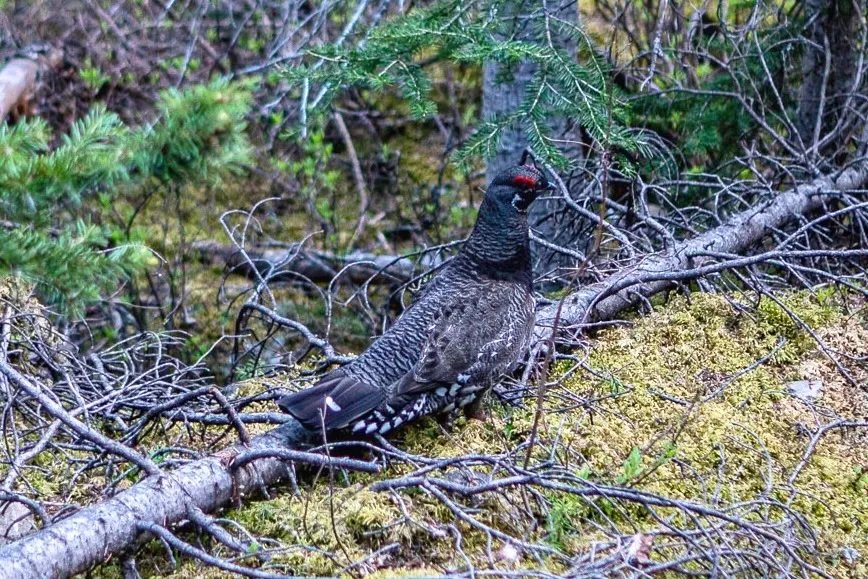
The spruce grouse (Canachites canadensis) is a small, dark forest grouse of the boreal and subalpine conifer forest. In Banff National Park, spruce grouse are year-round residents of dense spruce, pine, and fir stands; the bird most often seen on the wetter, shadier upper trails, where the closely related ruffed grouse is less likely to occur.
Identification
Compact and chicken-sized. Males are slate-black with a bright red comb above the eye, white spotting along the flanks, and a chestnut band at the tail tip. Females are cryptically barred in brown and grey. Distinct from ruffed grouse by darker overall plumage, the red eye comb, and the lack of a fanned tail with a dark band.
Habitat and diet
Dense conifer cover; spruce, lodgepole pine, and subalpine fir. Winter diet is heavily conifer needles, an unusual specialty for a North American bird, with buds, berries, leaves, and insects in summer. Often seen on or near the ground, picking grit and gravel from the forest floor.
Behaviour
Famously tame; sometimes called “fool hen” by trappers and hikers because individual birds may sit and watch you pass at close range rather than flush. In spring, males display from low branches with tail-fanning and short flutter flights. Roost in snow burrows in deep winter for insulation.
Viewing
Watch the trail edges in conifer-heavy forest. Plain of Six Glaciers, Lake Agnes, and the Pipestone trails are all reasonable bets. They are often heard before they are seen; a soft cluck or the rustle of needles. Maintain distance, especially during nesting (May–June), and never feed wild grouse.
Runs
Upper Grouse and Lower Grouse on the Front Side are named after the grouse family generally; both spruce and ruffed grouse occur in the resort’s forested terrain.